The Vajrapani Institute for Wisdom Culture,
riding the waves of consciousness on the surfboard of wisdom and compassion
Saturday, May 5, 2007
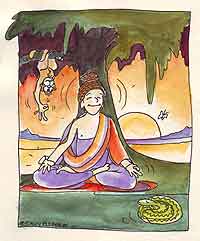
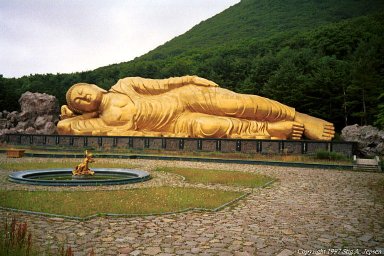
The Buddha was (is) here
The Vajrapani Institute for Wisdom Culture,
Labels:
Buddha,
Budhhism,
FPMT,
Santa Cruz,
Vajrapani
Thursday, May 3, 2007
My take on the dynamics of alcoholism/addiction
Hi! I just wrote what follows in a letter to a friend of mine. To save time, I typed in all lower caps.
This represents 20 years of my meditation on alcoholism/addiction. This letter reflects my thoughts. Others will agree and disagree. Take what you like and leave the rest. :^)
alcoholism is a scientifically established disease. i will try to explain a few of its features:
* when an alcoholic has alcohol in his body, he loses all connections to everyone else. to the practicing alcoholic, their number one priority is getting drunk, and once that drunk is over, getting loaded again and again. once the alcohol is in the alcoholic, he withdraws, and disconnects from others and non-drinking experiences. his primary purpose is to become intoxicated; everything and everyone else revolve around his need to drink and his ability to do so, uninterrupted.
* it's essential to know, however: the behaviors of an alcoholic have their basis in the neurological "hardwiring" of the alcoholic's brain.
* the biological dynamics of alcoholism can be understood through science's discoveries of the evolutionary development of the brain -- or the brain's roots, if you will.
* the most primitive parts of the brain go back so far in evolution as to be pre-cognitive. they are practically reptilian. this ancient, pre-civilized part of the brain emerged first; later the cognitive lobes evolved into being.
* the first developed parts of the human brain have more power over the brain as a whole, than the parts that developed later. this is true in every human brain.
* the most evolutionary primitive parts of the brain are also recognized as the brain's "pleasure centers." they control the production and regulation of "pleasurable" biochemicals such as dopamine and serotonin. it is here that all human emotions first emerge.
* the neurology of the alcoholic/addict is hyper-sensitive: even to the brain's simplest neurochemical functioning. this is one of the features that differentiate the biology of the alcoholic from that of a non-alcoholic. the alcoholic's neurochemical stability is always in a state of potential imbalance. often, the alcoholic's body -- i.e., his primitive brain/pleasure centers -- do not produce enough neurotransmitters, or do not sufficiently regulate them. a common result is that the alcoholic does not feel mentally stable enough to live without some sort of quick external intervention.
* in the beginning, the body's pleasure centers equate the presence of alcohol in the body with physiological pleasure and give feedback to the body that it is experiencing pleasure. the alcoholic therefore drinks and enjoys the experience. he may not consciously realize that he "self-medicating" with liquor in order to feel mentally, emotionally and dispositionally even.
* this neurochemically-imbalanced, conditioned stimulus and response creates an overexcited mind-behavior feedback loop that propels the alcoholic's future drinking. this feedback loops reinforces the alcoholic's drinking even when toxic symptoms of the drinking begin to appear, such as hangovers, changes of personality and "blackouts."
* the primitive regions of the brain, driven by a neurologic disharmony due to the alcoholic brain's functioning, fixate this destructive behavior in the alcoholic. because the primitive brain overrules the cognitive components of the brain that developed after it, it is at this point that the alcoholic may have "crossed over the line" that requires his drinking without his conscious consent.
* these primitive parts of the brain are pre-cognitive. they determine the alcoholic's behavior without needing to route the decision-making through the brain's cognitive functions. the conscious mind of the alcoholic does not decide whether the alcoholic will drink. under the active influence of alcohol, the alcohol does not have the choice but to drink.
* this pre-cognitive mechanism in the neuro-dysfunctional brain of an actively-drinking alcoholic illustrates why alcoholics get drunk even when they are rationally trying to consciously control their drinking. this is why appeals to the alcoholic's reasoning, emotions or values do not make any dent in the alcoholic's inebriation.
* most alcoholics are depressives; that is, they suffer from depression of a medical nature. try as he may, the alcoholic cannot bring himself out of depression with alcohol or the other drugs that the alcoholic abuses. nevertheless, the alcoholic will try to quash his depression with sedatives (e.g., alcohol), or a combination of sedatives and stimulants.
* the alcoholic may try a variety of different stimulants in combination with alcohol to strike the "right (artificial) balance." these stimulants can be any of the following: cocaine, speed, crack, methamphetamine, and so on. the alcoholic may try to elevate his depression with the use of stimulating behaviors, such as: negative excitement, anger, codependent "drama," compulsive or obsessive sex with a partner, anonymous or casual sex, gambling, argumentation, and so on. the active alcoholic, caught in the grips of neurochemical havoc, will go to any (ultimately self-defeating) lengths to try to restore a semblance of peace to his insane thinking.
* try as he might, eventually the destructive behaviors the alcoholic lavishes upon himself and others catch up to him in the shape of almost every possible negative thing that could happen to a person. this compounds the neurological imperative to seek what has now become oblivion through drink.
* science is also discovering evidence that alcoholism and other addictions have specific genetic roots. scientists are very close to locating the genes that will lead to alcoholism in an individual. not surprisingly, the combination of these particular "alcoholic" genes are similar to the combination of genes that lead to depression.
* it's not clear why some people with the alcoholic gene will drink alcoholically (or act out addictedly), while some people with the same genes won't. the differences are probably based on psychological and sociological factors that bring out the particular expressions of each alcoholic. some alcoholics do not drink alcoholically until they are in the right environment, such as high school, college or work. some alcoholics, such as myself, are born with such a severe neurochemical imbalance that we gravitate to, even actively search out "fixes" such as alcohol from a young age. [i was a blackout drinker from the beginning of my drinking. i was 13.]
* the time-tested programs of Alcoholics Anonymous (meant for the alcoholic) and Al-Anon (meant for people close to an alcoholic) stand by their experience: no one can diagnose whether a person is actually alcoholic except that person. in my opinion, the alcoholic must come to an innermost realization within himself that he has no power whatsoever over his drinking. ultimately, in order to recover from alcoholism, the alcoholic must make his own diagnosis, and then determine if he wants treatment for his disease. i/we/you/they may be sure that a person is an alcoholic, but it's likely that my/your/our/their opinions will not change the alcoholic's distorted perceptions of himself.
the impact of alcoholism on the lives of others
* alcoholism, in addition to being a biological/neurological disease, is also a mental disease.
* when alcohol is in the body of an alcoholic, he is completely under the control of an imbalance that has set off a craving/neurochemical imperative in his body. over this craving, he has absolutely no physical or mental control. the presence of alcohol in the body of an alcoholic also sets off an obsession in his mind, bringing him back to thinking over and over about drinking and getting loaded. this obsession preempts all of the alcoholic's perceptions.
* alcoholism is a disease of perception and denial. over all evidence to the contrary, the alcoholic will rearrange all his perceptions of reality in order so that he can drink as he is compelled to drink. this includes denial of his alcoholism. this includes trying to manipulate and control everyone around the alcoholic so that he is successfully able to blame his drinking on his perceived problems of others. alcoholics are great at creating drama in order to try to distract others from mirroring to him that he is an alcoholic.
* the compelling power of an alcoholic -- doing all that he can to also distort the thinking of others, so that they will be confused as to the fact of his alcoholism -- inevitably harms the perceptions, thinking and feeling of those closest to him.
* the alcoholic can make everyone around him feel like they are crazy and that he is the only sane one among them. one day he admits to his friends or family that he is somehow responsible for his "bad luck." the next day he categorically denies any responsibility for his problems and denounces his friends as traitors for implying he has a problem with drugs or alcohol.
* i can only describe the power of the pathology that the alcoholic inflicts upon others as malevolent. at the same time, the alcoholic is in the grip of a disease that is beyond his reason to control, muchless "manage," as try he might. so what can be done?
* no one, including the loved ones of an alcoholic, can work out his addiction for him. i/we/you/them cannot love him enough, guilt him enough, clean up after him enough, beg him enough, threaten him enough in order to get him to stop drinking. this is never my/your/our/their fault.
* no practicing alcoholic will ever take responsibility for his drinking, unless he is placed in physical, mental, emotional and spiritual circumstances that are completely beyond his ability to control. [and that is just the beginning of recovery.]
* the alcoholic must be made to reckon with the consequences of his drinking, with or without the helpful hand of others. often, the alcoholic will lean on the support of others, while in actuality never taking the meaningful steps forward to his sobriety. that is why the friends of an alcoholic must learn to detach from him -- spiritually, mentally, emotionally and even physically -- for his good. BUT MORE IMPORTANT, FOR THEIR OWN GOOD!
This represents 20 years of my meditation on alcoholism/addiction. This letter reflects my thoughts. Others will agree and disagree. Take what you like and leave the rest. :^)
alcoholism is a scientifically established disease. i will try to explain a few of its features:
* when an alcoholic has alcohol in his body, he loses all connections to everyone else. to the practicing alcoholic, their number one priority is getting drunk, and once that drunk is over, getting loaded again and again. once the alcohol is in the alcoholic, he withdraws, and disconnects from others and non-drinking experiences. his primary purpose is to become intoxicated; everything and everyone else revolve around his need to drink and his ability to do so, uninterrupted.
* it's essential to know, however: the behaviors of an alcoholic have their basis in the neurological "hardwiring" of the alcoholic's brain.
* the biological dynamics of alcoholism can be understood through science's discoveries of the evolutionary development of the brain -- or the brain's roots, if you will.
* the most primitive parts of the brain go back so far in evolution as to be pre-cognitive. they are practically reptilian. this ancient, pre-civilized part of the brain emerged first; later the cognitive lobes evolved into being.
* the first developed parts of the human brain have more power over the brain as a whole, than the parts that developed later. this is true in every human brain.
* the most evolutionary primitive parts of the brain are also recognized as the brain's "pleasure centers." they control the production and regulation of "pleasurable" biochemicals such as dopamine and serotonin. it is here that all human emotions first emerge.
* the neurology of the alcoholic/addict is hyper-sensitive: even to the brain's simplest neurochemical functioning. this is one of the features that differentiate the biology of the alcoholic from that of a non-alcoholic. the alcoholic's neurochemical stability is always in a state of potential imbalance. often, the alcoholic's body -- i.e., his primitive brain/pleasure centers -- do not produce enough neurotransmitters, or do not sufficiently regulate them. a common result is that the alcoholic does not feel mentally stable enough to live without some sort of quick external intervention.
* in the beginning, the body's pleasure centers equate the presence of alcohol in the body with physiological pleasure and give feedback to the body that it is experiencing pleasure. the alcoholic therefore drinks and enjoys the experience. he may not consciously realize that he "self-medicating" with liquor in order to feel mentally, emotionally and dispositionally even.
* this neurochemically-imbalanced, conditioned stimulus and response creates an overexcited mind-behavior feedback loop that propels the alcoholic's future drinking. this feedback loops reinforces the alcoholic's drinking even when toxic symptoms of the drinking begin to appear, such as hangovers, changes of personality and "blackouts."
* the primitive regions of the brain, driven by a neurologic disharmony due to the alcoholic brain's functioning, fixate this destructive behavior in the alcoholic. because the primitive brain overrules the cognitive components of the brain that developed after it, it is at this point that the alcoholic may have "crossed over the line" that requires his drinking without his conscious consent.
* these primitive parts of the brain are pre-cognitive. they determine the alcoholic's behavior without needing to route the decision-making through the brain's cognitive functions. the conscious mind of the alcoholic does not decide whether the alcoholic will drink. under the active influence of alcohol, the alcohol does not have the choice but to drink.
* this pre-cognitive mechanism in the neuro-dysfunctional brain of an actively-drinking alcoholic illustrates why alcoholics get drunk even when they are rationally trying to consciously control their drinking. this is why appeals to the alcoholic's reasoning, emotions or values do not make any dent in the alcoholic's inebriation.
* most alcoholics are depressives; that is, they suffer from depression of a medical nature. try as he may, the alcoholic cannot bring himself out of depression with alcohol or the other drugs that the alcoholic abuses. nevertheless, the alcoholic will try to quash his depression with sedatives (e.g., alcohol), or a combination of sedatives and stimulants.
* the alcoholic may try a variety of different stimulants in combination with alcohol to strike the "right (artificial) balance." these stimulants can be any of the following: cocaine, speed, crack, methamphetamine, and so on. the alcoholic may try to elevate his depression with the use of stimulating behaviors, such as: negative excitement, anger, codependent "drama," compulsive or obsessive sex with a partner, anonymous or casual sex, gambling, argumentation, and so on. the active alcoholic, caught in the grips of neurochemical havoc, will go to any (ultimately self-defeating) lengths to try to restore a semblance of peace to his insane thinking.
* try as he might, eventually the destructive behaviors the alcoholic lavishes upon himself and others catch up to him in the shape of almost every possible negative thing that could happen to a person. this compounds the neurological imperative to seek what has now become oblivion through drink.
* science is also discovering evidence that alcoholism and other addictions have specific genetic roots. scientists are very close to locating the genes that will lead to alcoholism in an individual. not surprisingly, the combination of these particular "alcoholic" genes are similar to the combination of genes that lead to depression.
* it's not clear why some people with the alcoholic gene will drink alcoholically (or act out addictedly), while some people with the same genes won't. the differences are probably based on psychological and sociological factors that bring out the particular expressions of each alcoholic. some alcoholics do not drink alcoholically until they are in the right environment, such as high school, college or work. some alcoholics, such as myself, are born with such a severe neurochemical imbalance that we gravitate to, even actively search out "fixes" such as alcohol from a young age. [i was a blackout drinker from the beginning of my drinking. i was 13.]
* the time-tested programs of Alcoholics Anonymous (meant for the alcoholic) and Al-Anon (meant for people close to an alcoholic) stand by their experience: no one can diagnose whether a person is actually alcoholic except that person. in my opinion, the alcoholic must come to an innermost realization within himself that he has no power whatsoever over his drinking. ultimately, in order to recover from alcoholism, the alcoholic must make his own diagnosis, and then determine if he wants treatment for his disease. i/we/you/they may be sure that a person is an alcoholic, but it's likely that my/your/our/their opinions will not change the alcoholic's distorted perceptions of himself.
the impact of alcoholism on the lives of others
* alcoholism, in addition to being a biological/neurological disease, is also a mental disease.
* when alcohol is in the body of an alcoholic, he is completely under the control of an imbalance that has set off a craving/neurochemical imperative in his body. over this craving, he has absolutely no physical or mental control. the presence of alcohol in the body of an alcoholic also sets off an obsession in his mind, bringing him back to thinking over and over about drinking and getting loaded. this obsession preempts all of the alcoholic's perceptions.
* alcoholism is a disease of perception and denial. over all evidence to the contrary, the alcoholic will rearrange all his perceptions of reality in order so that he can drink as he is compelled to drink. this includes denial of his alcoholism. this includes trying to manipulate and control everyone around the alcoholic so that he is successfully able to blame his drinking on his perceived problems of others. alcoholics are great at creating drama in order to try to distract others from mirroring to him that he is an alcoholic.
* the compelling power of an alcoholic -- doing all that he can to also distort the thinking of others, so that they will be confused as to the fact of his alcoholism -- inevitably harms the perceptions, thinking and feeling of those closest to him.
* the alcoholic can make everyone around him feel like they are crazy and that he is the only sane one among them. one day he admits to his friends or family that he is somehow responsible for his "bad luck." the next day he categorically denies any responsibility for his problems and denounces his friends as traitors for implying he has a problem with drugs or alcohol.
* i can only describe the power of the pathology that the alcoholic inflicts upon others as malevolent. at the same time, the alcoholic is in the grip of a disease that is beyond his reason to control, muchless "manage," as try he might. so what can be done?
* no one, including the loved ones of an alcoholic, can work out his addiction for him. i/we/you/them cannot love him enough, guilt him enough, clean up after him enough, beg him enough, threaten him enough in order to get him to stop drinking. this is never my/your/our/their fault.
* no practicing alcoholic will ever take responsibility for his drinking, unless he is placed in physical, mental, emotional and spiritual circumstances that are completely beyond his ability to control. [and that is just the beginning of recovery.]
* the alcoholic must be made to reckon with the consequences of his drinking, with or without the helpful hand of others. often, the alcoholic will lean on the support of others, while in actuality never taking the meaningful steps forward to his sobriety. that is why the friends of an alcoholic must learn to detach from him -- spiritually, mentally, emotionally and even physically -- for his good. BUT MORE IMPORTANT, FOR THEIR OWN GOOD!

Wednesday, May 2, 2007
Today is the Buddha's Birthday
"Non-Buddhists often ask whether or not Buddhists worship images. The images we pay homage to are only representations of one to whom we pay respect in gratitude because he, through his own efforts and wisdom, discovered the way to real peace and made it known to all beings. The offerings we make are but symbols of our reverence for the Buddha and are a means of concentrating our minds on the significance of the words we are reciting. Just as people love to see a portrait of one dear to them when separated by death or distance, so do we Buddhists love to have before us a representation of our teacher, because this representation enables us to think of his virtues, his love and compassion for all beings, and the doctrine he taught."
-- origination of quote unknown
Tuesday, May 1, 2007
The Nature of Mind
ON FINDING YOURSELF IN THE NATURE OF MIND
– an edited excerpt from oral teachings given by Geshe Tenzin Wangyal Rinpoche, Winter 2002
In order to directly experience the nature of mind, during dzogchen practice we try to create certain conditions within the body, speech and mind. We use postures or movements of the physical body, practices of the breath, and the concentration and focus of awareness of the mind.
It is not as if the nature of mind is a separate object, a separate place where you as a subject can take a bus, train or a plane to. It is not like that - there is no place to go, no place to search for the nature of mind. Nor is the nature of mind a form with a particular shape or color that you can experience. If you are searching for your nature in those ways, you will not find anything. That is guaranteed. We are so conditioned to always be expecting to see some THING. It is very, very difficult for us to rid ourselves of the mind of ours that has expectations.
If you go out to find a job, you go with the expectation of finding one that pays well, say. That expectation helps guide your search toward finding the right job for you. In looking for the nature of mind, though, it makes no sense to look with the expectation that you will see something, because there is nothing to see.
Now you may be thinking, "There's nothing to see? Well, that's a little discouraging." Maybe you are curious about what this means. You are beginning to realize that you cannot experience the nature of mind in the same way you can experience your dreams, your thoughts, your feelings, or any kind of form. The nature of mind will not be seen in any of those ways. It is possible that during meditation, sometimes you will see various colors or shapes that are signs or qualities of some experience of, or connection to, the nature of mind, but even these are not the nature of mind.
The introduction to the nature of mind is essentially about creating the right causes and conditions - that's really what it is. In the same way that by placing a mirror in different locations you find that your view changes, so too by putting your body in the right position, your breath in the right position, and your mind in the right position, you are able to simply find your self in that place. But when you find your self in that place, it is not that you are seeing something, it is only that you are being. The moment you think that you are seeing your nature, you are actually not. You see, one of the subtlest obstacles to resting in the nature of mind is not being able to get rid of the seer, the one who sees. Until you get rid of the observer, the perceiver, the subject, the nature remains hidden.
So, you don't create or force the experience of the nature of mind; rather, you can put the proper conditions together for finding your self there. It would be a good idea to look at all that we experience in our lives in that same way - understanding that we can't always achieve the results we want by forcing them, but we can instead try to set up the proper conditions for those results to arise naturally. Often we ignore the advantages of setting up the proper conditions and just struggle to force the result into manifestation.
For example, you want to be happy. So what do you do sometimes? You just try to force yourself to be happy, even though in a relative sense you are simply in the wrong place to support being happy. Let's say you are somebody who has a knack for electronics, who is fascinated working all day long on computers and has so much knowledge about how they work, and yet you may not be able to cook even a cup of tea for yourself. Now, if you were put into the position of being a chef at a restaurant, then that would definitely be the wrong place for you to be happy. So, you don't realize you are in the wrong place, the wrong time, the wrong situation, and all you know is that you want to be happy. The location makes you suffer, the situation makes you suffer, the timing makes you suffer, and yet you simply push yourself to be happy. You just cook furiously, and the customers continually are dissatisfied, and eventually the restaurant has to go out of business. That forcing of the situation would obviously be the wrong approach. What should you do instead? Focus your effort on changing the place, changing the timing, changing the circumstances to make them the right ones for being happy. If you do find the right conditions, then you'll be naturally happy. You create the causes for natural happiness rather than futilely struggling to force the result.
Many times in our lives we get stuck simply because we don't know we are trying to force a result that is not supported by our circumstances. We may only be repeating to ourselves, "I want to be happy, I want to be happy, I want to be happy." The added tension created by trying to force your happiness actually tends to worsen your situation. It actually creates the opposite effect, digging you deeper into that unfortunate situation. Do you see how that kind of narrow, result-oriented focus can be a kind of a secret obstacle for us at times?
This is especially true regarding the practices of the nature of mind. So, what is the introduction to the nature of mind? You understand that it is not the same as my saying "Look at this cup" (Rinpoche holds up a teacup). Rather, there are exercises, practices and techniques that all create a space where there is a greater chance to have experience. None of those techniques you learn are the nature of mind. None of those practices are the nature of mind. They are a very skillful means. In one important sense the only time you will have an experience of the nature of mind is when you are not practicing. But you must begin with the practice and then during the session you forget the practice. How can you forget the practice? When you come to the place where there is nothing at all you could call effort, that is the moment when you find yourself in the nature of mind: free from your thoughts, feelings, emotions and conditions, abiding in the space of infinite potential, in which there is a cause for the perfection of every experience that could arise. There is a sense of nothing lacking, because everything is perfected. The sense of longing, lacking, missing, not having enough - none of those experiences are there. On the contrary, there is the sense of being complete, perfected, whole; and you find your self.
So, regarding the introduction to the nature of mind, the important point here is not to get too attached to the techniques or methods, but to work with them so you can create the right position of the body, the right breathing, the right focus of the mind. If you are able to bring together the right conditions of body, energy and mind, then there is no way not to experience your nature. As we always say, there is no power or force that could possibly stop the result when all the causes and conditions are together. The same is true with regard to being happy. If all the causes and conditions for your being happy are together there, you will naturally be happy, and there is no force at all that can stop you from being happy and make you suffer. Likewise, if those causes and conditions are not there, if the causes and conditions are the wrong ones, then there is no force that can make you feel good. That is why the whole notion of cause and effect, or the law of karma, is so important in the dharma.
So, we must develop those causes and conditions that support the experience of the nature of mind without being too attached to the techniques or practices. This does not mean you don't learn how to do the practices precisely; you do learn them - very precisely. However, it's just like an old man who walks from one place to another with the help of a walking stick: His goal is to arrive at the new location, not simply to become attached to the walking stick, right? We also know that if the old man tries to walk there without the stick, for sure he will not reach his goal. Therefore, when walking to the new location he makes sure he has a firm grasp of the sturdy stick that supports him. Once he reaches his destination, the walking stick is no longer important to him. The practices, the techniques, are exactly like that. The methods are exactly like that. They never lose their potential to be of benefit when the need arises, but just don't get attached to them. Is that clear?
Thanks to Rick for posting this at http://bonreligion.tribe.net/
– an edited excerpt from oral teachings given by Geshe Tenzin Wangyal Rinpoche, Winter 2002
In order to directly experience the nature of mind, during dzogchen practice we try to create certain conditions within the body, speech and mind. We use postures or movements of the physical body, practices of the breath, and the concentration and focus of awareness of the mind.
It is not as if the nature of mind is a separate object, a separate place where you as a subject can take a bus, train or a plane to. It is not like that - there is no place to go, no place to search for the nature of mind. Nor is the nature of mind a form with a particular shape or color that you can experience. If you are searching for your nature in those ways, you will not find anything. That is guaranteed. We are so conditioned to always be expecting to see some THING. It is very, very difficult for us to rid ourselves of the mind of ours that has expectations.
If you go out to find a job, you go with the expectation of finding one that pays well, say. That expectation helps guide your search toward finding the right job for you. In looking for the nature of mind, though, it makes no sense to look with the expectation that you will see something, because there is nothing to see.
Now you may be thinking, "There's nothing to see? Well, that's a little discouraging." Maybe you are curious about what this means. You are beginning to realize that you cannot experience the nature of mind in the same way you can experience your dreams, your thoughts, your feelings, or any kind of form. The nature of mind will not be seen in any of those ways. It is possible that during meditation, sometimes you will see various colors or shapes that are signs or qualities of some experience of, or connection to, the nature of mind, but even these are not the nature of mind.
The introduction to the nature of mind is essentially about creating the right causes and conditions - that's really what it is. In the same way that by placing a mirror in different locations you find that your view changes, so too by putting your body in the right position, your breath in the right position, and your mind in the right position, you are able to simply find your self in that place. But when you find your self in that place, it is not that you are seeing something, it is only that you are being. The moment you think that you are seeing your nature, you are actually not. You see, one of the subtlest obstacles to resting in the nature of mind is not being able to get rid of the seer, the one who sees. Until you get rid of the observer, the perceiver, the subject, the nature remains hidden.
So, you don't create or force the experience of the nature of mind; rather, you can put the proper conditions together for finding your self there. It would be a good idea to look at all that we experience in our lives in that same way - understanding that we can't always achieve the results we want by forcing them, but we can instead try to set up the proper conditions for those results to arise naturally. Often we ignore the advantages of setting up the proper conditions and just struggle to force the result into manifestation.
For example, you want to be happy. So what do you do sometimes? You just try to force yourself to be happy, even though in a relative sense you are simply in the wrong place to support being happy. Let's say you are somebody who has a knack for electronics, who is fascinated working all day long on computers and has so much knowledge about how they work, and yet you may not be able to cook even a cup of tea for yourself. Now, if you were put into the position of being a chef at a restaurant, then that would definitely be the wrong place for you to be happy. So, you don't realize you are in the wrong place, the wrong time, the wrong situation, and all you know is that you want to be happy. The location makes you suffer, the situation makes you suffer, the timing makes you suffer, and yet you simply push yourself to be happy. You just cook furiously, and the customers continually are dissatisfied, and eventually the restaurant has to go out of business. That forcing of the situation would obviously be the wrong approach. What should you do instead? Focus your effort on changing the place, changing the timing, changing the circumstances to make them the right ones for being happy. If you do find the right conditions, then you'll be naturally happy. You create the causes for natural happiness rather than futilely struggling to force the result.
Many times in our lives we get stuck simply because we don't know we are trying to force a result that is not supported by our circumstances. We may only be repeating to ourselves, "I want to be happy, I want to be happy, I want to be happy." The added tension created by trying to force your happiness actually tends to worsen your situation. It actually creates the opposite effect, digging you deeper into that unfortunate situation. Do you see how that kind of narrow, result-oriented focus can be a kind of a secret obstacle for us at times?
This is especially true regarding the practices of the nature of mind. So, what is the introduction to the nature of mind? You understand that it is not the same as my saying "Look at this cup" (Rinpoche holds up a teacup). Rather, there are exercises, practices and techniques that all create a space where there is a greater chance to have experience. None of those techniques you learn are the nature of mind. None of those practices are the nature of mind. They are a very skillful means. In one important sense the only time you will have an experience of the nature of mind is when you are not practicing. But you must begin with the practice and then during the session you forget the practice. How can you forget the practice? When you come to the place where there is nothing at all you could call effort, that is the moment when you find yourself in the nature of mind: free from your thoughts, feelings, emotions and conditions, abiding in the space of infinite potential, in which there is a cause for the perfection of every experience that could arise. There is a sense of nothing lacking, because everything is perfected. The sense of longing, lacking, missing, not having enough - none of those experiences are there. On the contrary, there is the sense of being complete, perfected, whole; and you find your self.
So, regarding the introduction to the nature of mind, the important point here is not to get too attached to the techniques or methods, but to work with them so you can create the right position of the body, the right breathing, the right focus of the mind. If you are able to bring together the right conditions of body, energy and mind, then there is no way not to experience your nature. As we always say, there is no power or force that could possibly stop the result when all the causes and conditions are together. The same is true with regard to being happy. If all the causes and conditions for your being happy are together there, you will naturally be happy, and there is no force at all that can stop you from being happy and make you suffer. Likewise, if those causes and conditions are not there, if the causes and conditions are the wrong ones, then there is no force that can make you feel good. That is why the whole notion of cause and effect, or the law of karma, is so important in the dharma.
So, we must develop those causes and conditions that support the experience of the nature of mind without being too attached to the techniques or practices. This does not mean you don't learn how to do the practices precisely; you do learn them - very precisely. However, it's just like an old man who walks from one place to another with the help of a walking stick: His goal is to arrive at the new location, not simply to become attached to the walking stick, right? We also know that if the old man tries to walk there without the stick, for sure he will not reach his goal. Therefore, when walking to the new location he makes sure he has a firm grasp of the sturdy stick that supports him. Once he reaches his destination, the walking stick is no longer important to him. The practices, the techniques, are exactly like that. The methods are exactly like that. They never lose their potential to be of benefit when the need arises, but just don't get attached to them. Is that clear?
Monday, April 30, 2007
As of today, I have been sober for 7,015 days
... one day, one hour at a time. ;^D
Alcoholics Anonymous
Count the number of days that you have been sober.
Find an AA meeting in your area.
Sunday, April 29, 2007
The Heart Sutra
The Heart Sutra
"Hear, Shariputra, all dharmas (teachings) are marked with emptiness; they are neither produced nor destroyed, neither defiled nor immaculate, neither increasing nor decreasing. Therefore, in emptiness there is no form, feeling, intention, or consciousness; no eyes, ears, nose, tongue, body, or mind; no forms, sounds, smell, tastes, touches, or mental objects; nor is there the realm of the eyes, up to and including the realm of mind consciousness. There is no ignorance or ending of ignorance; up to and including no decay and death or ending of decay and death. There is no suffering, no origination of suffering, no extinction of suffering, and no path; no knowledge and also no attainment.
"Because there is no attainment, the bodhisattvas, supported by the Prajnaparamita, find no obstacles for their minds. Having no obstacles, they overcome fear, liberating themselves forever from illusion and realising perfect Nirvana. All Buddhas in the past, present, and future, through reliance upon Prajnaparamita, arrive at full, right, and universal Enlightenment.
"Therefore, one should know that Prajnaparamita is a great spiritual mantra, a great wisdom mantra, a supreme mantra, an unequalled mantra. It destroys all suffering because it is the incorruptible truth. A mantra of Prajnaparamita should therefore be proclaimed. This is the mantra:
"GATE GATE PARAGATE PARASAMGATE BODHISVAHA."
pronounced as:
"gah-teh gah-teh, pah-ra-gah-teh, pah-ra-sum-gah-teh, boo-di so-ha"
LA through the eyes of a Los Angeleno
I grant Patrick artistic license, but I don't like the fact that he didn't photograph Echo Park Lake, which is in my neighborhood, and is one of the prettiest and most special places in Los Angeles. Echo Park Lake is home to the largest lotus garden in the US. Contrary to the photographer, my neighborhood is not as shitty a place as his few photos makes it look. (Yes, I am a little hurt.)
Wikipedia has a good take on
LA through the eyes of a stranger

Friday, April 27, 2007
Why having a guru is so important

Just try to learn the truth by approaching a spiritual master. Inquire from him submissively and render service unto him. The self-realized soul can impart knowledge unto you because he has seen the truth.
The path of spiritual realization is undoubtedly difficult. The Lord therefore advises us to approach a bona fide spiritual master in the line of disciplic succession from the Lord Himself. No one can be a bona fide spiritual master without following this principle of disciplic succession.
The Lord is the original spiritual master, and a person in the disciplic succession can convey the message of the Lord as it is to his disciple. No one can be spiritually realized by manufacturing his own process, as is the fashion of the foolish pretenders.
The Bhagavatam says: dharmam tu saksad bhagavat-pranitam--the path of religion is directly enunciated by the Lord. Therefore, mental speculation or dry arguments cannot help one progress in spiritual life.
One has to approach a bona fide spiritual master to receive the knowledge. Such a spiritual master should be accepted in full surrender, and one should serve the spiritual master like a menial servant, without false prestige.
Satisfaction of the self-realized spiritual master is the secret of advancement in spiritual life. Inquiries and submission constitute the proper combination for spiritual understanding. Unless there is submission and service, inquiries from the learned spiritual master will not be effective.
One must be able to pass the test of the spiritual master, and when he sees the genuine desire of the disciple, he automatically blesses the disciple with genuine spiritual understanding. In this verse, both blind following and absurd inquiries are condemned. One should not only listen submissively to the spiritual master, but one must also get a clear understanding from him, in submission and service and inquiries.
A bona fide spiritual master is by nature very kind toward the disciple. Therefore when the student is submissive and is always ready to render service, the reciprocation of knowledge and inquiries becomes perfect.
Labels:
God,
guru,
Hinduism,
spiritual mastery,
spirituality,
Teachers
About A Course in Miracles
This is the text of a letter that I sent to a new AA/writer friend of mine, gÃNgst€® Bo¥s¢oUt.
Hey, G! I hope you don't mind addressing you as "G," but I don't have the typeset to spell out your full tribes.net moniker. Actually, that's a lie. I am just lazy.
I swore after just writing you that I was going straight to bed. Naturally, when I declare I am going to sleep, I tell myself first that I can graze the web for another 5 minutes ... and here I am.
I saw your reference to "A Course in Miracles." My [AA] sponsor Rick Saslaw knew Marianne Williamson; they knew each other very well. Rick used to take me to hear MW speak. She spoke twice a week in LA during the 80s and early 90s. I was just 18 months into sobriety and quite raw. Rick took me to Alanon meetings and ACIM talks given by MW. A lot of my ideas about my HP came to me through Rick, through MW and ACIM.
MW was quite a delightful, conscious lady human being with a wise heart and a nose for bullshit. Nothing got past her.
Rick had AIDS. He had given so much to AA and to lots of charities throughout LA, but he almost always balked at getting or asking for help. MW helped to run an organization called Project Angel Food, which prepares and delivers meals to people with HIV/AIDS. Rick was running out of money and he would never eat at home.
Rick was brilliant and defiant: the worst combination in an alcoholic. I was pretty much Rick's primary caretaker; but he wouldn't ask Project Angel Food for help, and he wouldn't let me ask. Finally, I called Marianne. I didn't think she would remember me, but all I had to say to her was Rick's name, and that he was jeopardizing his life by not eating. We knew about AIDS wasting syndrome. Marianne called Rick right then. She prodded him until he was willing to accept Project Angel Food's help. THAT was a deep dish course in miracles. The next day, the deliveries began and Rick began to eat again.
I called Marianne again about a year later. Her book, "Return to Love" had become a bestseller, and she was in the middle of her second book tour. I let her know that Rick had died.
A half-year or so before, I caught MW at a break during one of her lectures. I introduced myself again. I asked her if she would officiate at Rick's memorial service when he died. She agreed on the spot. I don't think I told Rick. I must have. It's just that he and I could barely talk about his death.
It was shortly after the day that I last saw Rick; I placed a large sunflower from my garden on the back of his burly naked body: lying in the dark in his tiny bathroom. I didn't really get to see him. His body blocked the bathroom door from opening except for just a little bit.
Then the Neptune Society came, picked him up, cremated him, and later poured his ashes into the sea. The Neptunes don't let people ride on their boats to come to say goodbye. [I hope that it was dignified.]
Marianne paused her RTL tour and officiated at Rick's memorial at this postage stamp of a park tucked below Sunset Strip. All of Rick's eccentric friends and AAs -- crowded onto this petit lawn. Of course, we were in West Hollywood. A hundred or so feet above us, in the zenith of a sterling day, was the Sunset Strip, all its vampires vouchsafed until the night; three of four blocks below, down the hill, was Boy's Town and the bars.
It got hot. I was wearing this blue wool business suit, and holding on to Rick's huge stuffed monkey doll. The monkey made me itch more than the suit. At the podium, I made the most nonsensical remarks about Rick and his stuffed monkey. Marianne salvaged the hour's empty disposition, basically giving us an ACIM lecture, a discourse on Rick Saslaw. It was the most fitting tribute Rick could ever have had.
Rick's been gone 14 years now. I haven't seen MW since.
I have Rick's copy of RTL. I have read and reread the book dozens of times. My sponsee Matt will attest to all of the sentences covered with neon shades of highlighting pens, underlined by my ecstatic shaky hand, and my furious emphatic notes that cram the margins and whatever blank space I could find in the front and back. Lovingly illustrated with light bulbs, lightning bolts, happy faces, flowers and hearts, it's a hippie's journal. But it's my book, and I don't care if it does look kind of gay.
Matt has taken to reading RTL. With most of many sponsees, this strategy of mine hasn't worked.
I am always going on to Matt and my other sponsees about the necessity of cultivating positive spiritual energy in sobriety. RTL is the perfect spiritual energy textbook for this. And it's getting through to him.
At first, I lent Matt Rick's copy/my copy of RTL. Then, I bought him a mint first-edition hardback copy of RTL on Amazon. This outcome relieves me and makes me very happy. His ex-girlfriend loves RTL, too. Actually, I couldn't open the book for several years after Rick had gone, but I treasured it until I could read it.
Of course, RTL is something that I will always read. That and the Big Book and my book on the Prajnaparamita Sutra. I always have one or more of those books on me at all times. They are my talismans.
I have had four sponsors, one of which still works with me now, and they are all sacred to me. Each one of my sponsors has made me into the sober and spiritual mensch that I am today. [I will say I'm a mensch; they were for me, and now I am in their place.] With great giddiness and reverence, I talk on and on about my sponsors to my sponsees. I'm not sure if they are suffering this fool gladly, but I can't help myself.
(And thanks for being there, Marianne.)
Thursday, April 26, 2007
The power of truth and responsibility is surfacing in the U.S. Congress
From Air America:
"The House on Wednesday narrowly approved a $124 billion war spending bill that would require American troops to begin withdrawing from Iraq by Oct. 1, setting the stage for the first veto fight between President Bush and majority Democrats. The Senate is expected on Thursday to approve identical legislation, which provides more than $95 billion for combat operations in Iraq and Afghanistan through Sept. 30, with the money conditioned on the administration’s willingness to accept a timetable for withdrawal and new benchmarks to assess the progress of the Iraqi government."
Video: Representative John Murtha, Chairman of the House Defense Committee, Pushes for Passage of the "Iraq Accountability Bill."
Video: Representative Patrick Murphy, Who Served in Iraq in 2003-4, Grieves the Loss of His Fellow Soldiers, and Demands a Fall 2007 Withdrawl of U.S. Troops From Iraq.
Thanks to AMERICAblog.com for the videos.
Wednesday, April 25, 2007
Tuesday, April 24, 2007
Can mysticism save us now?
Can Rumi save us now?
Life and words of the popular 13th-century Persian poet have special meaning for a 21st-century world torn by war, genocide and hatred
Jonathan Curiel, Chronicle Staff Writer
Sunday, April 1, 2007
During the last decades of his life, the Persian poet Rumi was surrounded by news of terrorism, just as we are eight centuries later. Those were the days of Mongol invasions that swept past the steppes of Asia into Anatolia, the Near East and other areas of geographical importance. Mass murders from war -- what today would be called genocide and ethnic cleansing -- were a routine part of Rumi's 13th-century world.
So, where's the bloodshed in Rumi's writing? Where are all the parables about gore and conflict and Mongol atrocities?
Nowhere, really, say Rumi scholars, pinpointing a central incongruity to the poet's life: Rumi, a man so advanced in Islamic training that he could issue fatwas, divorced himself from talk of revenge, retribution and eye-for-an-eye killings. Like Jesus, Gandhi and Martin Luther King Jr., Rumi insisted violence was an unsatisfying way of resolving issues. In fact, Rumi believed people could find salvation in their enemies' hatred.
"Every enemy is your medicine ... your beneficial alchemy and heart healing," Rumi says in his epic six-volume work, the Mathnavi, as translated by Majid Naini, an Iranian American scholar. "Carry the burden smilingly and cheerfully, because patience is the key to victory."
Sentiments like that have turned Rumi into one of America's best-selling poets -- someone whose thoughts on love and other matters are revered by hundreds of thousands of readers.
Rumi had already found an audience in America before 9/11, but interest in the mystic from Persia (now Iran) -- and in his beautiful words; in his sometimes funny stories; in his all-inclusive message that the faithful of all religions have a common humanity -- has mushroomed in the past six years. In recognizing this year as the 800th anniversary of Rumi's birth, the United Nations Educational, Scientific and Cultural Organization, which is known as UNESCO, calls Rumi an "eminent philosopher and mystical poet of Islam" whose "work and thought remain universally relevant today."
Scores of concerts and events will mark the anniversary, including a celebration on Thursday and Friday in San Francisco that features Coleman Barks, the retired University of Georgia professor widely credited with popularizing Rumi in the United States.
Go to Borders, Barnes & Noble or any neighborhood bookstore, and you're likely to find many more Rumi titles than books by Robert Frost or Walt Whitman. Besides poetry shelves, Rumi is prominent in bookstores' calendar, religious and music sections. Rumi's words -- lyrical and resonant, especially when voiced in Persian -- lend themselves perfectly to musical expression. Charles Lloyd, the brilliant saxophonist who played with Ornette Coleman and Eric Dolphy in the 1960s, is among the jazz artists who've recently paid musical tribute to Rumi.
So, who is Rumi, really? He was a mystic and a scholar. He was an adherent of religious Islam (his full name was Jalal al-Din Muhammad Balkhi) who did the hajj to Mecca, but who, in the later part of his life, famously said, "I am not a Jew nor a Christian, not a Zoroastrian nor a Moslem." By that, says Naini, Rumi meant that his faith in God, in Allah, knew no boundaries -- that it didn't matter what country he lived in, or what official religion he designated, because the love and longing that Rumi felt was everywhere, including his soul.
"Keep in mind that the holy Quran states there is no force in religion," says Naini, a Rumi expert who has lectured on the poet at the United Nations. "Rumi wants to remind us that we are all children and the creation of God, regardless of religion, race, color, nationality, etc."
Born on Sept. 30, 1207, in what is today the area of Balkh, Afghanistan, Rumi might have been a religious cleric all his life were it not for Shams of Tabriz, a wandering dervish whom Rumi met at age 38. As chronicled in Naini's book, "Mysteries of the Universe and Rumi's Discoveries on the Majestic Path of Love," Tabriz challenged Rumi's perspective by asking him if the mystic Bayazid Baastami was "higher" in stature than the Muslim Prophet Muhammad. By confronting Rumi in a public space, and daring to compare Bayazid and Muhammad, Shams unnerved Rumi, who encountered someone unafraid to make a spectacle and question religious orthodoxy.
Out of that first meeting in Konya, Turkey, Rumi and Shams became inseparable. Shams was at least 20 years older than Rumi, and untrained in strict Islamic theology, yet Rumi -- who was the highest Muslim authority in Konya -- chose Shams to be his mentor. As noted by Naini, Shams asked Rumi to relinquish himself from the trappings of his fame and fortune, and to focus just on an unadorned, selfless connection to God. To "disconnect from the world of desires and dependencies," as Naini notes, and to enter into a higher spiritual devotion to the Almighty, Rumi followed Shams' advice to perform a whirling dance called Samaa, and to listen to mystical music performed on a reed flute. (Rumi practiced the Samaa on an empty stomach, says Naini.) Islamic traditionalists considered Rumi's new actions heretical.
Seven centuries later, some Muslim fundamentalists still say the movement that Rumi spawned -- the Mevlevi, also known as the Whirling Dervishes -- is un-Islamic because of its emphasis on public song and dance. But Naini and other scholars rebut that, saying Rumi and his followers are emblematic of Islam's Sufi tradition, which emphasizes a mystical closeness to God, and to other humans, regardless of their faith. It's this universality that appeals to Rumi's readers and accounts for the still-growing interest in Rumi's work.
Westerners who may be otherwise afraid of Islam see in Rumi and the Mevlevi a form of the religion that features dancing, music and talk of brotherly and sisterly fellowship. They see someone from Persia who turned his back on hatred and revenge. In the current climate of war and warmongering, Rumi left behind volumes of work that have gained relevance as time has passed.
Rumi didn't try to sugarcoat his life or the lives of others. After Shams mysteriously disappeared, Rumi felt sorrow for many years. His stories of trying to retain a closeness to God through love and loss are at the heart of his writing.
In "Mysteries of the Universe," Naini emphasizes Rumi's thoughtfulness on science, music, and nature, but Rumi's biggest gift to readers today may be his emphasis on the power of love and tolerance.
"Rumi said, 'From love, thorns become flowers,' " Naini says. "Rumi teaches that even if the Devil falls in love, he becomes something like (the angel) Gabriel, and that evilness dies within him."
The Rumi Concert, sponsored by the California Institute of Integral Studies, takes place at 8 p.m. Thursday and Friday at the Palace of Fine Arts in San Francisco. For more information, visit www.ciis.edu/publicprograms/spring07/rumi_concert.html. E-mail Jonathan Curiel at jcuriel@sfchronicle.com.
Labels:
Islam,
Literature,
Poetry,
religion,
Rumi
Subscribe to:
Posts (Atom)
Blog Archive
-
▼
2007
(81)
- ► 09/09 - 09/16 (3)
- ► 09/02 - 09/09 (4)
- ► 08/19 - 08/26 (2)
- ► 07/29 - 08/05 (3)
- ► 07/15 - 07/22 (1)
- ► 07/08 - 07/15 (1)
- ► 07/01 - 07/08 (1)
- ► 06/24 - 07/01 (1)
- ► 06/17 - 06/24 (2)
- ► 06/10 - 06/17 (3)
- ► 06/03 - 06/10 (2)
- ► 05/27 - 06/03 (2)
- ► 05/20 - 05/27 (7)
- ► 05/13 - 05/20 (7)
- ► 05/06 - 05/13 (8)
- ► 04/29 - 05/06 (12)
- ► 04/22 - 04/29 (11)
- ► 04/15 - 04/22 (10)
About Me, the Vajra Surfer वज्र
- Vajra Surfer वज्र
- Los Angeles, California, United States
- Hi! ✌ I am a flower-picking ❀ redwood-tree-hugging, ♻ green-party-progressive, 21¼-century reincarnation of John ☮ Lennon from the ♆ spiritual vortex of Santa Cruz, California! I'm a Egytpo-Grecian☥, Neo-Platonic⊿, Gnostic☿, Buddhist⎈-Hinduૐ-Daoist䷀䷁ mystic⁂ and ϕhilosopher-king. 兡 Beyond my preternatural affability there is some acid and some steel.™ I've sober for ⨦20 years. 兡 I like to sing 吉 in my car like I am ☆ live onstage. I chant, which is kind of like singing, except more introverted. I pray for peace 平 and for the enlightenment of all beings. 曰月
Surf Reports
- Transformer of Hatred
- Prajnaparamita Sutra
- Perfection of Wisdom (Wikipedia)
- Manjushri Mandala
- Lex Hixon
- Jalal ad-Din Muhammad Rumi (Wikipedia)
- Healing Iraq
- For friends/families of alcoholics and/or addicts
- Dimensional Harmonic Matrix - Unified Field Theorem Set Alpha
- Bill Wilson
- Ashes and Snow
- Alcoholics Anonymous
Vajrapani, Holder of the Vajra
om vajrapani hung phet